How Canadian drone manufacturers can move from prototype builds to repeatable, traceable production.
Canada’s Armed Forces currently hold about 2,000 drones. On September 10, 2026, Prime Minister Mark Carney said the country will need millions, and set a goal of building the industrial capacity to produce millions of drones within the next two years, with one-third of that production going to support Ukraine.
Going from thousands to millions is not a design problem. It is a manufacturing problem.
The groundwork is already being laid. The Defence Drone Initiative was launched to accelerate the development, testing and production of Canadian uncrewed and autonomous systems. The National Research Council of Canada is investing C$105 million over three years in a new Drone Innovation Hub to support drone and counter-drone development and testing, and to strengthen Canada’s sovereign supply chain.
The question is no longer whether Canada can develop advanced drones. It is whether Canadian manufacturers can build them repeatedly, efficiently and at the volumes now being targeted.
Why Innovative Automation Should Be Part of the Conversation Early
Drone companies bring deep expertise in aircraft design, autonomy, navigation, communications and payloads. Scaling production requires a different discipline: designing the manufacturing systems that turn those technologies into repeatable products.
That is the work Innovative Automation has done since 1989. From its facility in Barrie, Ontario, the company designs and builds custom automation for complex assembly and testing applications, with mechanical, electrical, controls and robotics engineering working together on one team. Innovative Automation is well qualified to engineer drone automation machines around the UAV or UAS itself: its components, its required cycle time, its quality requirements and its path to volume.
Timing matters. When an automation partner joins the conversation while the product is still maturing, the production process can be shaped around the drone, rather than retrofitting automation around decisions that are expensive to change.
The Math Behind Drone Production at Scale
Volume changes everything about how a product has to be built.
Illustrative takt time for one facility running two 8-hour shifts, five days a week, 50 weeks a year, before downtime.
Even if national volume is spread across many manufacturers and facilities, each production line still has to hit a takt time that leaves little room for manual adjustment, rework or inconsistent inspection.
At prototype volumes, engineers can tweak each build and inspect each component by hand. At production volumes, the manufacturing process becomes part of the product. Cycle times must be consistent, and every assembly step has to be repeatable. Testing must produce meaningful results for every unit, and problems need to surface before they spread across a production run.
This is where industrial automation for drone manufacturing becomes essential. The goal is not simply to place a robot in a factory. It is to engineer a production process that assembles, verifies and documents the same result every time.
Where Drone Manufacturing Automation Delivers the Most Value
No single approach fits every UAV or UAS manufacturer. The right strategy depends on the platform, production volume, product maturity and how often the design is still changing. Four areas typically offer the strongest return.
Drone Assembly Automation
Robotic systems can handle and position components, perform fastening and insertion operations, and move assemblies between stations. For manufacturers running multiple configurations, drone assembly automation with flexible tooling lets the line adapt as products evolve, without building an entirely new process for every model.
Electrical and Electronic Assembly
A drone is largely an electronic product: motors, batteries, sensors, wiring and communication systems. As volume grows, how those components are installed and connected becomes a major source of quality risk. Automation can verify each connection at the station where it is made, rather than discovering a fault at final test.
Machine Vision and Automated Inspection
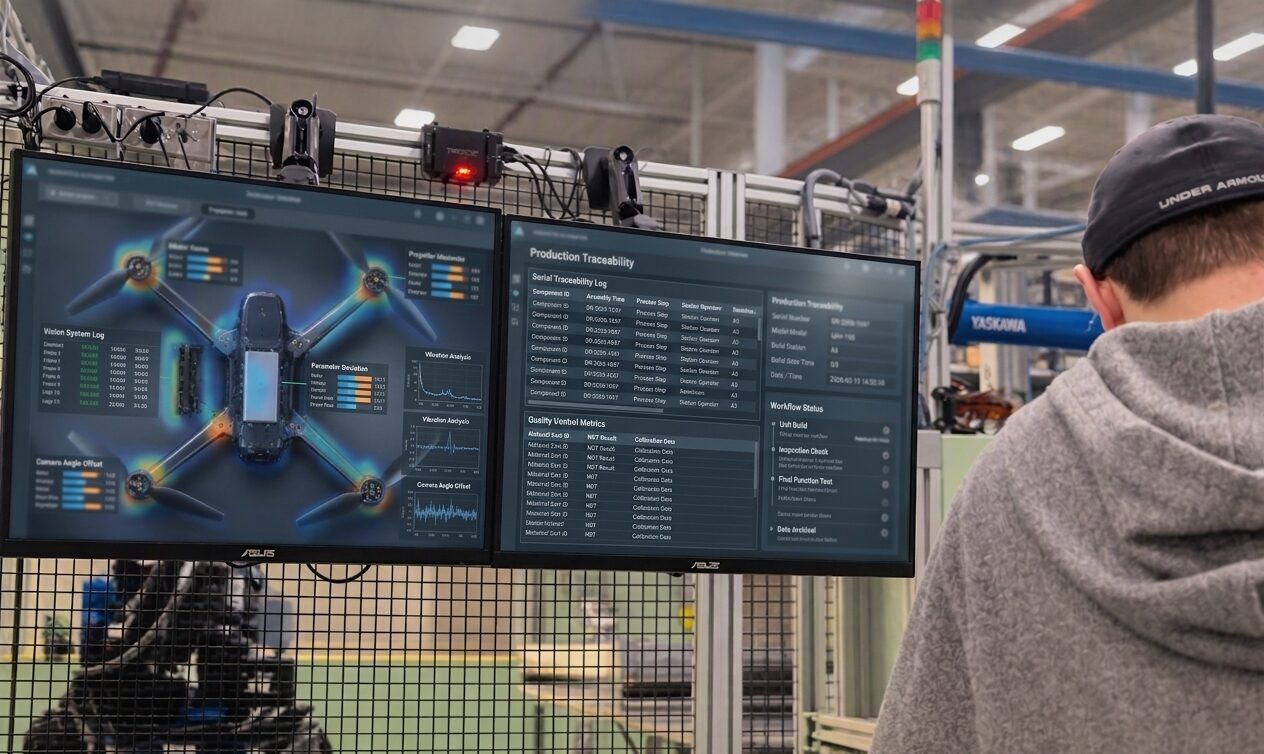
Machine vision can confirm component presence, position and orientation immediately after an assembly step. Inspection becomes part of the process rather than a separate gate at the end of the line, so an issue is caught before more value is added to a faulty unit.
Automated Drone Testing
A finished drone or subassembly has to perform as designed. Automated drone testing can be engineered around the product’s specifications to verify electrical, mechanical, dimensional or functional characteristics. Depending on the platform, this may include motor and controller function, firmware loading, sensor calibration or communication checks, with each result recorded automatically.
Assemble, Inspect, Test, Record
At higher volumes, these operations stop being separate steps and become one connected flow.
ASSEMBLE → INSPECT → TEST → RECORD
A station may assemble a component, verify its position with vision, perform a functional check and attach the result to the unit’s serial number. Over thousands of units, that data builds a production history for every drone. Quality teams can trace a field issue back to a specific build, spot recurring problems early and validate that the process is performing as intended.
For defence and aerospace applications, where manufacturers may need to show that every unit was built and tested to defined requirements, traceability is not an add-on. It is part of the manufacturing infrastructure. The objective is not just faster production. It is repeatable production with a record of what happened.
Design for Automation: Decisions Made Now Shape Production Later
Many of the factors that determine how efficiently a drone can be produced are set during design. How parts are presented to a robot affects cycle time. Fastener choices affect whether a step can be automated reliably. Test access points determine how quickly a unit can be verified, and datum features affect how accurately a part can be fixtured.
Bring Automation In Before the Design Is Frozen
An automation partner involved early can flag these issues while they are still inexpensive to change. That is one of the strongest reasons to engage an experienced integrator during production development, rather than after demand has already arrived.
Built in Ontario, for Canadian Production
Ontario has one of North America’s most established manufacturing and automation ecosystems. For Canadian drone manufacturing, the opportunity is not limited to the aircraft. It also includes the production equipment that builds it.
Working with a Canadian automation company has practical advantages: shorter travel for design reviews and factory acceptance testing, easier collaboration between engineering teams, and production equipment built within Canada’s own supply chain.
Innovative Automation’s Assembly Systems combine robotic assembly, component handling, fastening and vision-guided processes in production systems designed around the product. Its Test & Inspection systems verify product characteristics and integrate testing directly into the manufacturing process. Together, they give drone manufacturers in Ontario and across Canada a foundation for production that can scale while maintaining quality, consistency and traceability.
Ready to Scale Drone Production?
Canada’s drone industry is taking off. The manufacturing systems behind it need to be ready to scale.
From automated assembly and robotic handling to machine vision, testing and traceability, Innovative Automation helps manufacturers build the production infrastructure needed for repeatable, scalable drone manufacturing.
If you’re evaluating how to scale drone production in Canada, our sales and engineering teams are ready to discuss the next step.