Every manufacturing company eventually reaches a point where its existing processes are no longer sufficient to support the next stage of growth.
Production is running. Demand is increasing. But stability becomes harder to maintain. Engineering teams spend more time correcting variation than improving throughput. Hiring becomes more difficult. Skilled labor becomes less predictable.
This shift was already well established by 2024. According to McKinsey’s report, Automation and the talent challenge in American manufacturing, the sector is facing a structural labor shortage that could leave between 1.5 million and 2.5 million manufacturing roles unfilled by 2030, while demand for production continues to increase. At the same time, tighter labor markets and growing product complexity are forcing manufacturers to adopt automation to sustain productivity, stabilize operations, and allow skilled workers to focus on higher-value engineering and process improvement roles.
Automation is no longer driven only by efficiency. It is increasingly driven by necessity.
Over more than 35 years designing custom automation systems, we’ve seen this pattern consistently. Companies rarely automate because they want to. They automate because their processes demand greater stability, repeatability, and traceability than manual systems can reliably provide.
Automation follows complexity.
Stability Begins With Process Understanding
Automation projects rarely begin with equipment. They begin with engineering analysis.
Torque variation in screw driving. Inconsistent riveting results. Heat staking variability. Micro dispensing tolerances becoming harder to maintain. Foam dispense inconsistency due to environmental conditions. Tape dispense alignment requiring manual correction. Leak testing failures appearing late in production.
These are indicators that the process itself has reached its stability limits.
Manual processes can perform exceptionally well, but they rely on human consistency. As production volume increases or product complexity grows, maintaining repeatability becomes increasingly difficult.
Industrial automation systems stabilize these processes through torque-controlled fastening, validated dispensing systems, integrated vision systems, and structured process verification and data collection. This allows manufacturers to maintain consistent performance regardless of volume, shift, or operator variation.
Automation brings control to the physical layer of production.
Workforce Constraints Are Accelerating Automation Decisions
Workforce availability has become one of the defining challenges in modern manufacturing.
Deloitte’s 2026 Manufacturing Industry Outlook, published in late 2025, highlights workforce constraints as a critical operational risk and identifies automation and smart manufacturing investment as key strategies to address labor shortages and maintain competitiveness. The report found that 80% of manufacturers plan to allocate at least 20% of their improvement budgets toward smart manufacturing technologies, including automation, robotics, and digital systems.
This reflects a structural shift in how production systems are designed. Automation allows manufacturers to maintain consistent output while enabling skilled employees to focus on engineering, quality, and process optimization rather than repetitive manual tasks.
Automation strengthens the workforce by stabilizing production in an environment where workforce availability is no longer guaranteed.
Automation Supports Consistency Across All Production Levels
Automation has traditionally been associated with high-volume production. Today, the primary driver is process stability and flexibility.
According to the International Federation of Robotics, global installations of industrial robots numbered more than 542,000 units in 2024, one of the highest annual totals on record. At the same time, the total number of robots operating in factories worldwide exceeded 4.6 million units, reflecting widespread adoption across industries that demand precision, repeatability, and traceability.
This growth is not simply about increasing output. It reflects a broader shift toward stabilizing increasingly complex production environments through controlled and repeatable processes.
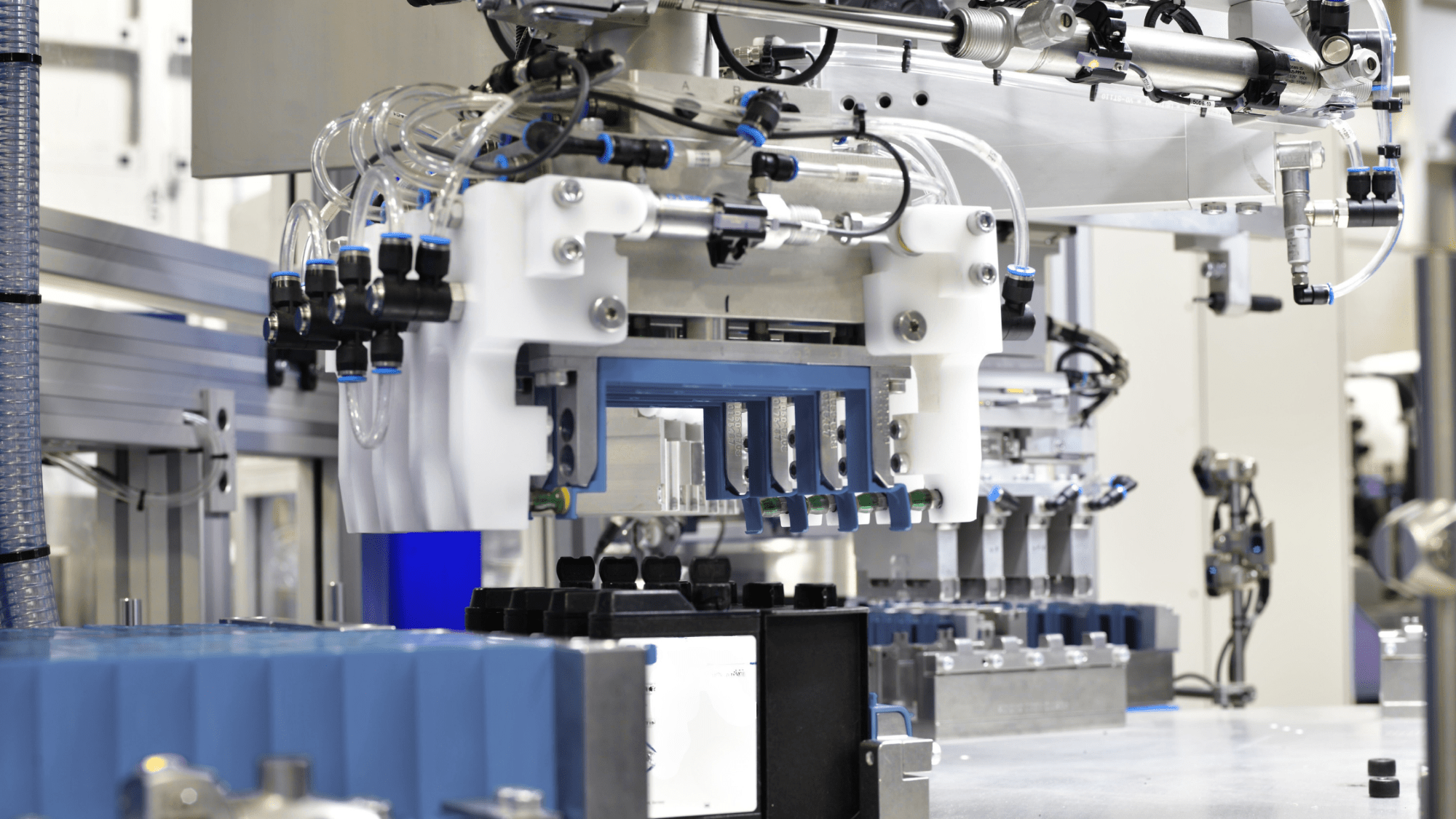
Flexible manufacturing automation systems using SCARA and 6-axis robotics, custom EOATs, conveyors, gantries, and dial tables allow manufacturers to maintain consistent performance regardless of production scale or product variation.
Automation is no longer defined by volume. It is defined by stability.
Integration Determines Long-Term Reliability
Automation reliability is determined by system integration quality.
Successful automation systems require coordinated expertise across mechanical engineering, controls engineering, robotics integration, and electrical system design.
At Innovative Automation, systems are designed and built in-house, including electrical panel fabrication, mechanical assembly, and controls integration. This approach allows for greater engineering control, higher build consistency, and more reliable long-term system performance.
Our Barrie, Ontario facility provides customers with the opportunity to see systems during development, validate performance, and collaborate directly with our engineering team. This ensures automation solutions align precisely with production requirements.
Automation works best when it is developed as a complete system, not as isolated equipment.
The Right Time to Automate
Automation is not defined by company size. It is defined by process stability requirements.
The right time to automate is when process variability begins to limit performance, when skilled labor becomes difficult to scale, or when production requires consistent, traceable, and repeatable results.
Manufacturers that understand their processes and work with experienced automation partners can implement systems that improve operational stability, production efficiency, and long-term scalability.
Automation is not the objective. Stability is. Automation is how stability is achieved.
If your production environment is reaching this point, our engineering team in Barrie is available to discuss your process requirements and evaluate potential automation strategies. Learn more about our capabilities and approach at www.innovativeautomation.com.