Gene and cell therapy manufacturing operates under conditions that fundamentally change how automation systems must be designed.
In most industries, a process deviation creates scrap or rework. In CGT manufacturing, the impact is different. A contamination event can eliminate a patient’s treatment window, and a process deviation can delay a therapy for which there may be no alternative.
This shifts the conversation around automation. It is no longer centered on throughput or efficiency alone. It becomes a question of how to design systems that can deliver precision, traceability, and regulatory alignment from the very beginning.
A Market That Cannot Scale on Manual Processes
The growth of the CGT sector reflects both opportunity and pressure. The global CGT manufacturing market was valued at USD 21.15 billion in 2025 and is projected to reach USD 215.18 billion by 2035, growing at a CAGR of 26.11%. More than 3,200 clinical trials are currently underway worldwide, with a global pipeline encompassing over 4,469 therapies from preclinical through pre-registration stages. And the sector is diversifying quickly: 51% of newly initiated gene therapy trials now target non-oncology indications, up from 39% just a year prior — a signal that CGT is moving well beyond oncology into rare diseases, neurological conditions, and other areas where manufacturing demand is still taking shape.3
Yet despite this growth, the industry faces a persistent bottleneck. Many therapies that reached commercialization did so through largely manual laboratory processes — processes that were acceptable at clinical scale but cannot support commercial production volumes without introducing variability, risk, and regulatory exposure. As programs advance from early research into late-stage development and beyond, scalability, reproducibility, and compliance have become the defining manufacturing challenges of the decade.
The answer is not simply deploying more equipment. It is purpose-built automation, systems designed specifically for the complexity, sensitivity, and regulatory demands of this environment.
What Makes CGT Manufacturing Fundamentally Different
Before selecting an automation partner, CGT manufacturers need to understand what makes this environment unique and what it demands from any system integrator.
Patient-specific variability. Many CGT therapies, particularly autologous CAR-T cell therapies, are manufactured from a single patient’s cells. There is no batch averaging, no second chance. Every run is unique, which means every system must be capable of high precision with minimal human intervention.
Sterility as a non-negotiable. CGT processes require closed systems, contamination-controlled environments, and careful material handling at every stage. Unlike traditional manufacturing where a contaminated unit is a quality event, in CGT it is a patient safety event.
Regulatory complexity at every step. FDA, Health Canada, and EMA all apply rigorous cGMP requirements to CGT manufacturing. Every process step must be documented. Every deviation investigated. Every change controlled. Systems that cannot generate clean, traceable records are systems that slow down — or stop — commercialization.
The scale-up challenge. Processes validated at clinical scale must be transferable to commercial scale without requiring full revalidation. This means automation needs to be designed with scalability in mind from the start — not retrofitted later. As one recent industry analysis noted, scaling CGT production from laboratory to commercial levels presents challenges unlike those seen in traditional pharmaceutical manufacturing — living cells cannot simply be produced in larger batches using superior tools. (Nova One Advisor, January 2026)
The Role of the Automation Integrator in CGT
In this environment, a systems integrator is not just a machine builder. They are a compliance partner, and the questions worth asking before awarding any project are not primarily about robot brand or cycle time.
The questions that matter are about how the integrator manages change, how they document design decisions, control software updates, respond to process deviations, and maintain a revision history that holds up under regulatory scrutiny. In a cGMP environment, a system that runs well on the floor but cannot demonstrate the documentation trail behind its design is a liability, not an asset.
At Innovative Automation, our approach to life sciences automation is built around delivering systems that align with the regulatory and validation expectations of our customers from the start. Our engineering process integrates structured design reviews, controlled change management, and cross-disciplinary collaboration across mechanical, electrical, controls, and fluid power systems.
We design and build systems with GAMP5 readiness in mind, including software lifecycle management, testing, and verification protocols that support IQ, OQ, and PQ execution. This ensures that automation systems are not only capable of performing, but are also prepared to be validated, documented, and deployed within regulated manufacturing environments.
Where Automation Delivers in CGT Manufacturing
While each CGT application is unique, there are consistent areas where well-designed automation delivers measurable value:
Assembly and handling precision. Small-scale, high-sensitivity components require sub-millimeter repeatability that manual processes cannot sustain at commercial scale. From cassette subassemblies to precision fluid path components, the tolerance for error in CGT is near zero.
Advanced Inspection and Vision Systems. Defect detection, label verification, and in-process quality control are areas where vision systems provide both speed and traceable data. Innovative Automation deploys vision-based inspection systems regularly across regulated manufacturing environments — systems that flag anomalies, log results, and generate records without relying on human interpretation at the point of inspection.
Automated calibration and process validation. One approach we have implemented across multiple projects is the use of automated validation routines — including the deliberate introduction of known-failure test parts at set intervals to continuously verify that quality checks are functioning as expected. This type of built-in verification is particularly valuable in regulated environments where demonstrating ongoing process control is a compliance requirement, not just a best practice.
MES integration for traceability. Innovative Automation has integrated with customer MES platforms to provide connected data capture across production steps. In CGT, where batch records are critical to product release, this connectivity is not a future upgrade, it is a foundational design requirement.
Environmental monitoring. Automated logging of temperature and environmental conditions during processing and storage is a capability we support, essential in CGT where biological material is time-sensitive and highly condition-sensitive.
Scalable platform design. Systems should be engineered to grow. Our experience scaling automated platforms — including programs taken from pilot to commercial production — demonstrates that we design with scalability built in from the start, not bolted on later.
The Compliance Layer That Most Integrators Miss
One of the most consistent risks in CGT automation projects is the gap between what an integrator can build and what a regulated manufacturer can actually put into production. A machine that performs well mechanically but lacks IQ/OQ/PQ validation documentation cannot be released. A software update that bypassed formal change control can invalidate a validation status. A system without clean audit records becomes a liability during FDA or Health Canada inspections rather than evidence of good manufacturing practice.
This is why the conversation with an automation partner needs to happen before the design phase, not after commissioning. Innovative Automation approaches CGT projects with IQ/OQ/PQ validation as a design input. Our engineering teams work through design reviews and failure mode analysis early, specifically to surface compliance risks while there is still room to address them without disrupting the build or the timeline.
What the Next Five Years Will Demand
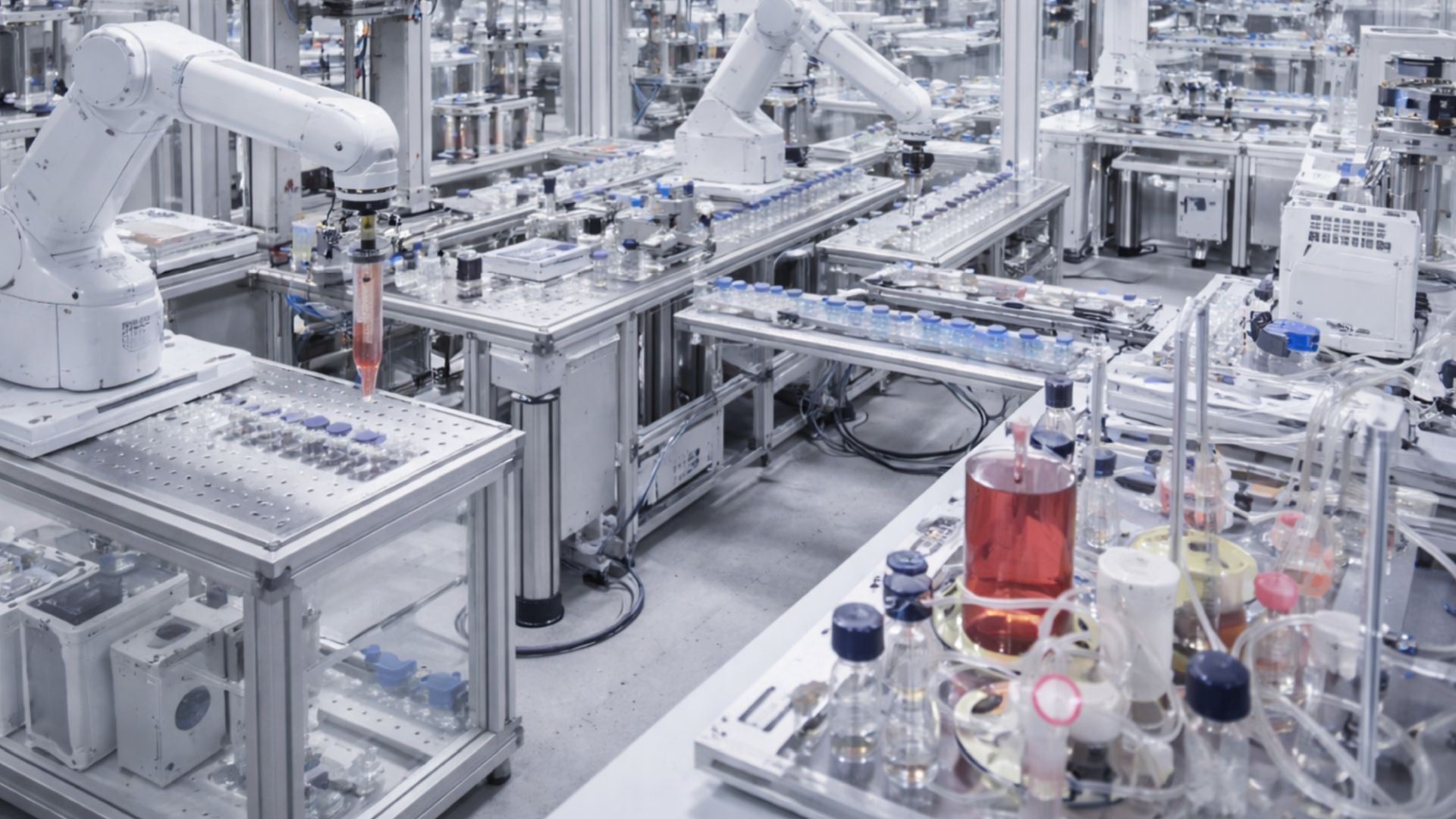
Fully integrated automation platform designed for sterile cell and gene therapy manufacturing environments.
The CGT sector is moving toward decentralized and platform-based manufacturing: modular production models where therapies are manufactured closer to the patient, or through standardized process platforms that can be validated once and deployed across multiple sites. Both directions will require automation that can be rapidly deployed, validated, and adapted to different facility footprints — and automation partners who understand regulatory requirements across FDA, Health Canada, EMA, and other jurisdictions simultaneously.
The fact that more than half of newly initiated gene therapy trials now target non-oncology indications means the applications that will drive next-generation manufacturing demand are still in early development. The organizations that will be positioned to serve those programs are not the ones waiting for CGT automation standards to fully mature. They are building the capability now — developing the quality systems, the technical depth, and the regulatory fluency that this sector requires.
Ready to Talk About Your CGT Automation Challenge?
Whether you are designing a new CGT assembly system, scaling a validated process to commercial production, or evaluating automation partners for an upcoming program, the conversation starts with understanding your regulatory environment — not just your throughput targets.
Innovative Automation works with life sciences manufacturers who cannot afford to get it wrong. If that describes your team, we would like to talk.
Contact us: sales@innovativeautomation.com | www.innovativeautomation.com