Automation projects are typically evaluated on what the machine produces: cycle times, throughput, system footprint, integration complexity. Those are the numbers that appear in proposals and get reviewed in project meetings.
The electrical control panel rarely enters that conversation early. It should be the first thing on the list.
The panel is not a peripheral component. It is the electrical and logical infrastructure that every other part of the automation system depends on. When a panel is well designed, the machine runs with precision and stability. When it is not, the consequences show up as downtime, extended maintenance windows, troubleshooting hours that compound across shifts, and safety risk.
The financial scale of those consequences is significant. According to Siemens’ True Cost of Downtime 2024 report, unplanned downtime costs the automotive sector an average of $2.3 million per hour, an increase of 113% from 2019 levels. The report found that equipment failures remain the primary driver of unplanned downtime events across manufacturing facilities. In automation systems, the electrical control panel is where those failures most often originate.
Over decades of designing and building custom automation systems, one pattern holds without exception: the quality of the control panel reflects the quality of the machine.
What an Electrical Control Panel Actually Does
In any automated system, whether a robotic assembly cell, a linear transfer line, or a multi-process integration, the control panel is the central nervous system of the machine.
It houses the PLCs, drives, safety relays, power distribution components, and I/O modules that allow the machine to operate, communicate, and respond. Every actuator, sensor, and motion component in the system runs through the panel. Fault detection, operator interface signals, and safety interlocks are all managed there.
When a machine stops unexpectedly during production, the investigation begins at the panel. How quickly you find the fault, how clearly the panel communicates what happened, and how safely a technician can access the relevant components determines how fast production resumes. At $2.3 million per hour, that is not a procedural consideration. It is a financial one.
Safety Is Not a Feature. It Is the Foundation.
Industrial control panel design in North America is governed by two primary standards: NFPA 79, the Electrical Standard for Industrial Machinery, and UL 508A, the Standard for Industrial Control Panels. Both were updated in 2024 and 2025 respectively, with new requirements around surge protection, short-circuit current ratings, labeling standards, and alignment with evolving automation technologies.
The 2024 NFPA 79 update introduced new requirements for Surge Protective Devices in sensitive and safety-related circuits, because voltage spikes from switching operations or external power events can silently damage PLCs, sensors, and operator interfaces. One packaging facility cited in the NFPA 79 training literature reduced control board failures by 70% within a year of retrofitting SPDs to their safety circuits. The UL 508A revision, which took effect June 26, 2025, aligns the standard with NFPA 79 and the National Electrical Code, updating requirements around components, wiring methods, and acceptable substitutions.
Compliance with these standards is the starting point, not the ceiling. What separates a panel that meets the standard from one that performs reliably across the full operating life of a machine is how the design was built to be used after commissioning, by the maintenance technicians who work with it every day on the customer’s floor.
” We design, build & test everything in house. Our dedicated panel shop has not only a very large capacity, but also the right equipment and specialized tools to produce the best panels this industry demands. That investment reflects how much we care about what goes into every panel we build. The panel is the heart of your machine. It may cost a little more to do things right, but it always costs far more not too.”
Bill Thomson, Electrician at Innovative Automation
That design intent is built at the build stage and experienced by the customer for the life of the machine. Inspection windows at eye level, not positioned in a way that requires a technician to crouch or reach, change how frequently checks are performed, how quickly anomalies are identified, and how safely maintenance can be conducted in an active production environment. A panel built for the person who will maintain it, not just the person who builds it, performs differently over time.
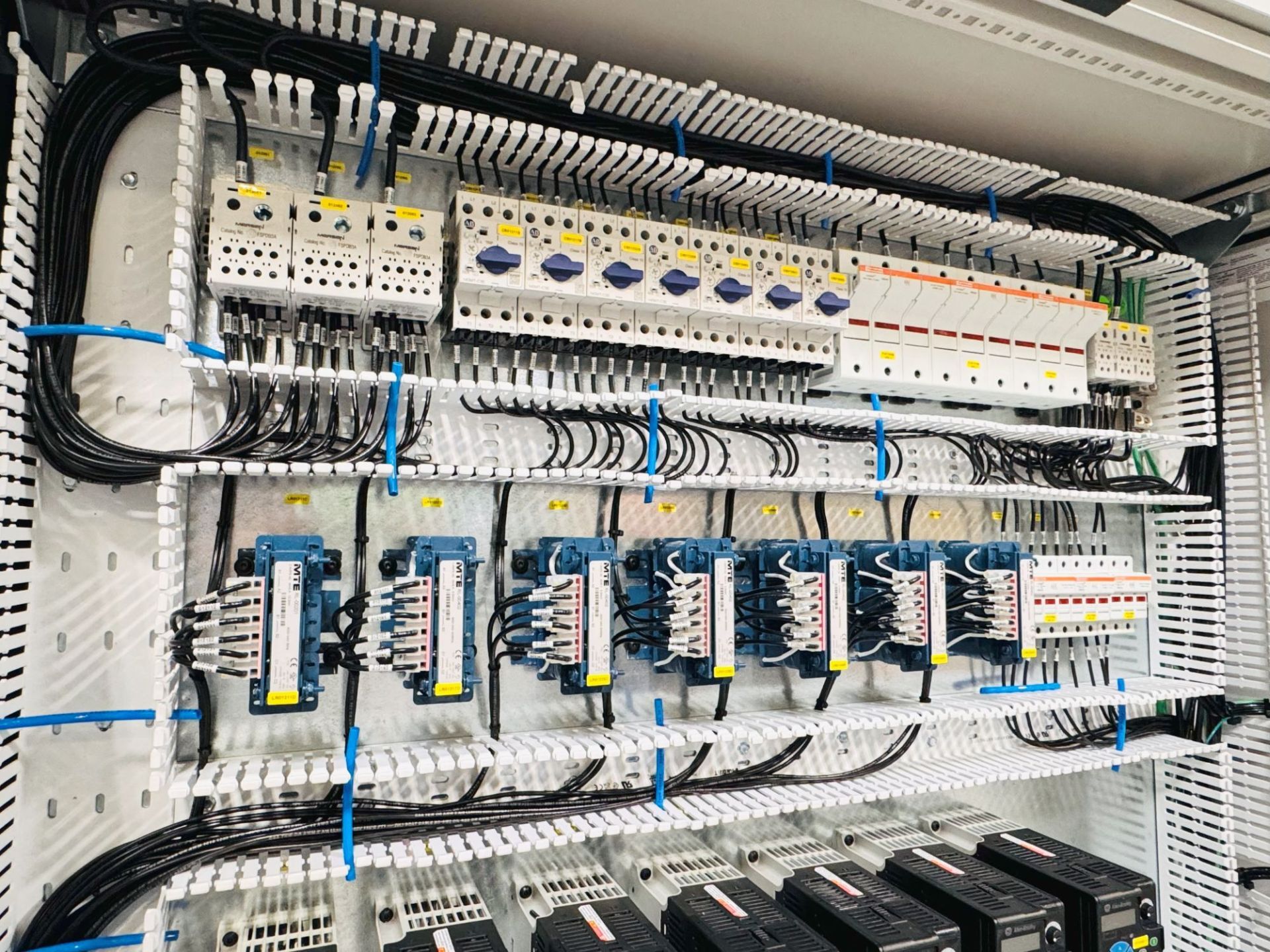
Finger-safe components, clearly labeled circuits, organized cable management, and structured fault accessibility are functional design decisions. They reduce risk and improve response time when something requires attention, whether that is a week after commissioning or five years into production.
What Goes Into a Panel That Has to Perform
Most people who specify automation systems never see inside the panel that runs them.
They see the machine. They see the cycle time. They see the output. What they do not see is what it took to build the electrical infrastructure that makes all of it work.
For one of Innovative Automation’s larger recent builds, the electrical team pulled more than 4 kilometers of cable through a five bay modular panel assembly. Assembled, routed, labeled, and terminated before the system ever left the facility. The panel was then fully disassembled for transport and rebuilt on-site at the customer’s floor, wire by wire, to the same standard it left the shop with.
“This is one of the largest panel assemblies we have built. When it is complete, there will be more than 4 kilometers of cable in that single system. It takes over ten trucks to move everything safely to the customer. And then we go there, reassemble everything on site, and run through every test until it meets the same standard it left the shop with.”
Mike Moreau, Electrician at Innovative Automation
That scale of electrical work requires more than technical skill. It requires a build standard that holds across the entire team. A panel that performs consistently in the field is one where every technician who touched it made the same decisions about routing, termination, and documentation.
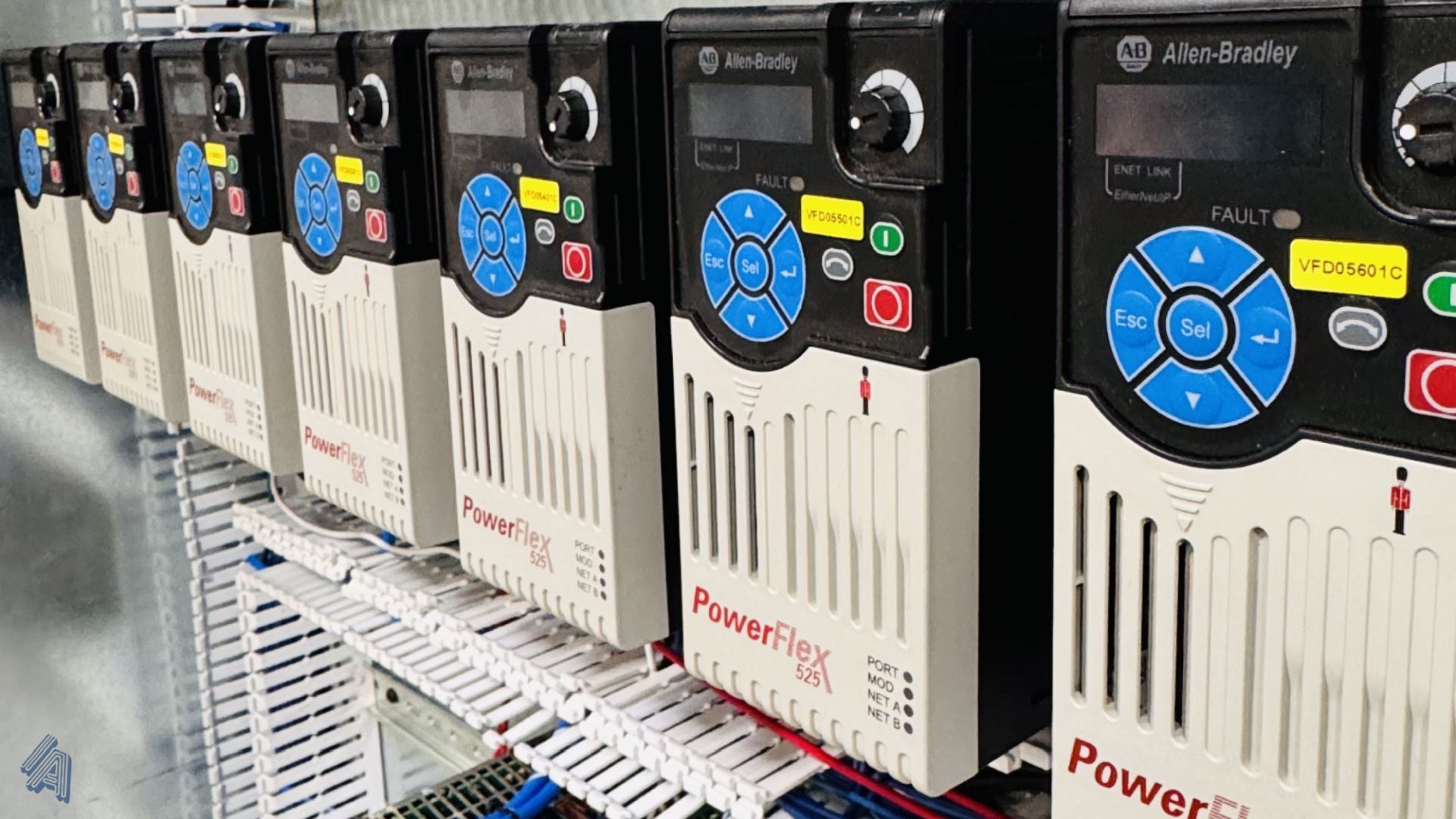
The electrical complexity our team builds to is not limited to a single project type. In another recent build, a separate panel housed seven PowerFlex drives, each requiring coordinated configuration, precise thermal management, and documentation detailed enough that any qualified technician can commission, troubleshoot, or service it independently. These are not exceptional projects. They represent the standard our electrical team works to across every build that leaves the facility.
The Team That Builds the Panel Goes to Site
One of the details that rarely appears in a proposal but matters significantly in practice: at Innovative Automation, the electricians who build the panel are the same team that travels to the customer’s facility to commission and install it.
That continuity is not a formality. The person who routed the cable, made the termination decisions, and built the documentation is the person standing in front of the panel when it is powered up for the first time on the production floor. They know where everything is. They know how the system was built. They can identify a fault, trace a circuit, and resolve a commissioning issue faster than any technician reading the system for the first time.
For the customer, that means a faster and cleaner commissioning process with a direct line of communication to the people who built the machine, not a third-party installation crew working from documentation they did not write.
In-House Fabrication as an Engineering Advantage
At Innovative Automation, electrical control panels are fabricated in-house at our Barrie, Ontario facility. That is a deliberate part of how our automation systems are designed and built.
Building panels in-house, rather than outsourcing fabrication, allows our engineering team to maintain direct control over design decisions, component selection, and build quality at every stage. It also enables tighter coordination between mechanical design, controls engineering, and electrical build, which matters significantly when integrating complex multi-process systems where panel performance must align precisely with machine behavior.
” Everything here is designed and built to the highest levels of safety. Even the ways in which we treat the startup and development of each new piece of equipment, demonstrates to me as a worker here at Innovative that safety never takes a back seat”
Bill Thomson, Electrician at Innovative Automation
That in-house capability also positions Innovative Automation to stay current with the evolving regulatory environment. The 2025 revision to UL 508A which took effect June 26, 2025, reflects growing alignment between industrial panel standards and broader electrical codes. Integrators who build panels in-house adapt to those changes within their own engineering process rather than managing compliance through an external fabricator.
What to Look for in a Control Panel Build
For manufacturing engineers and plant managers evaluating automation systems, the control panel is worth examining closely during both system development and commissioning.
A well-designed, standards-compliant panel demonstrates several characteristics. Safety architecture should include finger-safe components, proper separation of high and low voltage circuits, safety relay integration, and clearly accessible emergency stop and isolation points as required under NFPA 79 and UL 508A. Thermal management should include adequate ventilation and inspection windows for visual monitoring without requiring access to live components. Surge protection should be implemented in sensitive and safety-related circuits per the 2024 NFPA 79 requirements. Documentation and labeling should be complete enough that a maintenance technician can navigate the panel independently, without relying on the original builder’s presence.
A panel built to these standards does not eliminate faults. It significantly reduces the time and effort required to identify and resolve them. At the production downtime rates the industry is currently experiencing, that reduction carries measurable financial value across the operating life of the machine.
Automation Reliability Starts at the Panel
Automation systems are typically evaluated on what they can do: what they can assemble, test, dispense, or inspect. The electrical control panel determines how reliably all of that happens, and for how long.
A well-designed panel supports faster commissioning, clearer fault identification, safer maintenance, and more consistent performance over the system’s operating life. A poorly designed panel introduces risk at every one of those stages.
For manufacturers investing in custom automation systems, the panel is not the place to reduce cost. It is the place to invest in reliability.
Because in automation, the quality of the machine and the quality of the panel that runs it are the same thing.
Built In-House. By a Team That Builds Nothing Else.
Most automation integrators build machines. Few build the electrical infrastructure that runs them with the same level of internal ownership.
At Innovative Automation, the electrical team is not a support function. It operates as a discipline in its own right, with dedicated electricians, apprentices, and a build standard that runs parallel to mechanical and controls engineering from the first schematic to the final commissioning sign-off.
Every panel that leaves our Barrie facility is designed, built, labeled, and documented internally. No subcontractors. No shared resources. No handoffs between teams who have never been in the same room.
That structure produces something that is difficult to replicate on the outside: coherence. The mechanical engineer and the electrician working on the same build are solving the same problem, in the same facility, at the same time. Routing decisions, thermal management, component selection, documentation standards, these are made by people who understand what the machine needs to do, not just what the panel needs to contain.
The result is a system that arrives at the customer’s facility as a complete, integrated piece of work. Clean. Organized. Built to be maintained by someone who was never in the room when it was built.
That is what in-house electrical capability actually means at the level Innovative Automation operates. Not just a team that wires panels. A team that is part of how the machine is engineered.